
Garfield County Criminal Docket Searches
Begin a Garfield County criminal docket search in the Nebraska Judicial Branch Case Information service, known as JUSTICE. It reaches public trial-court records from both Garfield County Court and Garfield District Court. When you search by party name, copy the spelling exactly as the court paper prints it. Too many hits? Narrow with Garfield County, court type, case type, or year. A case number is faster when it appears on the citation, complaint, notice, or order.
For a remote name search, the JUSTICE public search charges a one-time fee of $17. It returns up to 30 public cases. The list stays viewable for three calendar days. You pay even if nothing turns up. Results can trail a new filing by about 24 hours. Check again later or confirm with the clerk.
- Start with the party name or the case number printed on the Garfield County court paper.
- Select Garfield County and choose County Court or District Court when that distinction is known.
- Add a criminal case type or year only if the name search needs narrowing.
- Open the matching Case Detail and read its Register of Actions in date order.
- Use the clerk route for a public terminal, a missing image, or a certified copy.
Note: A name search returns public case information only. It is not a certified court record, and it may not show every recent or restricted filing.
Garfield County JUSTICE Criminal Search
Let the paper record guide the filters. The JUSTICE interface offers party name, individual or entity status, county, court type, case type, year, judge, attorney, and sort controls. The state warns against narrowing too soon if a search could yield more than 30 results. The court document itself tells you the right spelling and the right court.
The official JUSTICE search-field illustration displays the filters. They help isolate a Garfield County criminal case.
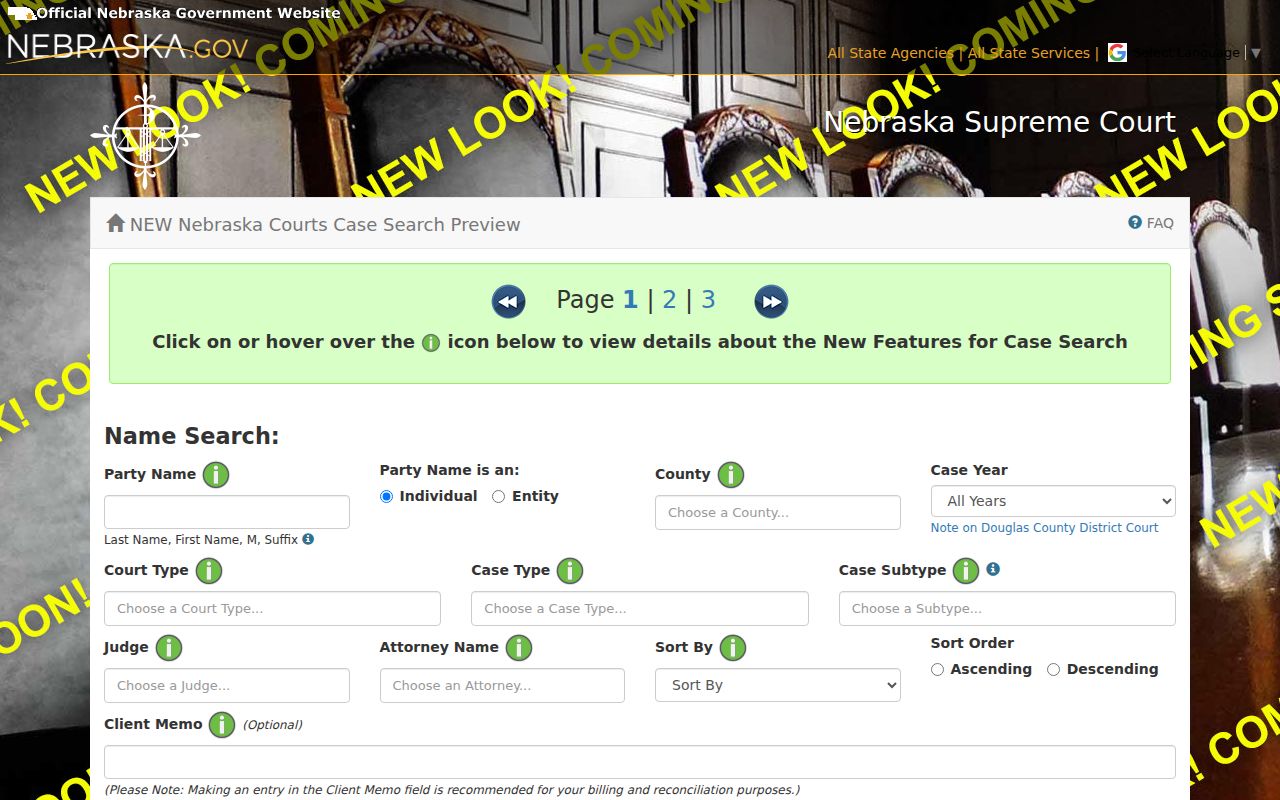
Pick the court that matches the case. County Court handles a misdemeanor or a preliminary felony record. District Court is where a felony trial record lives, when the court paper names that route.
Criminal Dockets: What They Show
A Garfield County criminal Case Detail page pulls together a header, a party list, financial activity where it applies, document links, and the Register of Actions. That register is the timeline. Entries may include a complaint, motion, notice, hearing, order, or disposition. A charge or a payment line is not a final result by itself. Find the later order, judgment, or disposition entry before concluding anything about the case.
| Case number | A court-generated identifier. A County Court criminal component pattern can read C NN CR YY ID for court, county number, criminal type, year, and assigned ID; use the displayed case number exactly. |
|---|---|
| Court and case type | Shows whether Garfield County Court or District Court holds the criminal matter and the category assigned by the system. |
| Offense information | Lists charge information when available. It does not establish a disposition. |
| Register of Actions | The dated sequence of filings, hearings, notices, orders, and other recorded case activity. |
| Status and disposition | Read the status with the later order or disposition entry rather than relying on a single event label. |
Public documents may be linked to an event. The portal treats filings after April 16, 2008 as generally having images, though availability can lag and confidential material stays withheld.
Reading a Garfield Criminal Register
Think of the Garfield County criminal Register of Actions as a timeline, not a report. Entries can include a complaint, summons, return, affidavit, motion, notice, order, financial event, or satisfaction. Each label only marks that something was recorded. Details live in the linked filing or order, when public. A warrant, bond, charge, or motion should be weighed against later entries. Never read it as the case outcome.
- Case Detail
- The case-level screen around the event register.
- Register of Actions
- The dated list of recorded filings, hearings, and orders.
- Disposition
- The recorded final outcome or order entry, if one has been entered.
- Setting
- A listed court event or hearing date that should be checked against the current calendar.
Need a future Garfield County setting? The separate statewide court calendar offers another channel. Its notice warns that calendar data may not be timely, so rely on the citation, notice, signed order, or an entry confirmed by the clerk.
Criminal Case Stages on the Docket
A Garfield County criminal case often starts with a filing, then moves through an initial hearing, arraignment, pretrial events, a plea or trial, disposition, and sentencing. The path varies with the charge and the court. The docket matters because it records each dated step, not just a final label. A continuance or later order can change what an earlier setting seemed to mean.
Docket flow: Filing › Arraignment › Pretrial › Plea or Trial › Disposition › Sentencing
Keep the case number with any Garfield County criminal notes. It helps track a transfer, appeal, or related matter. An appeal trail may show a notice of appeal and later mandate activity, and appellate case information sits apart from the trial-court event list.
Garfield County Criminal Filing Snapshot
The FY2025 County Court report lists 14 felony filings, 83 misdemeanor filings, and 50 traffic filings for Garfield County. The adult County Court total was 212 filings. These are fiscal-year filing counts, not a roster of people, convictions, open matters, or the number of public results a docket search will return.
Garfield District Court shows its own rows for the same fiscal year: one felony filing, three other-criminal filings, and 17 total adult filings. The split between courts is why a searcher should pick the court named on the document rather than assuming every criminal event sits in one Garfield County docket.
Garfield County Criminal Docket Courts
The criminal docket in Garfield County splits across two courts. Garfield County Court takes misdemeanors, traffic, and municipal-ordinance cases. It also holds preliminary hearings in felony matters. Felony trials belong to Garfield District Court, which also keeps criminal cases filed or moved there at the district level. Both courts feed JUSTICE. A preliminary proceeding in County Court and the later felony case in District Court can still be distinct records, so a Garfield County docket search may need both.
Call first with any case or date question. For County Court matters, that is Clerk Magistrate Bert Meschke at 308-346-4123. District Court felony docket and copy questions go to Clerk of the District Court Keri Koenigsberg, at 308-346-4161 or clerk@garfieldcountyne.gov. The two offices share an address: 250 South 8th, Burwell, NE 68823. Posted county hours are Monday through Friday, 8:30 to 12:30 and 1 to 4. The state listing differs. Call ahead before you drive over.
Garfield County Felony Docket Split
Garfield County belongs to Nebraska's Eighth Judicial District. That placement matters for felony searches. A felony charge often starts as a preliminary case in County Court, then becomes a separate trial record in District Court. Search the case number at each level. Check the Register of Actions in both courts too. The state District 8 court map shows where Garfield County sits within the district and how the local district structure is laid out.
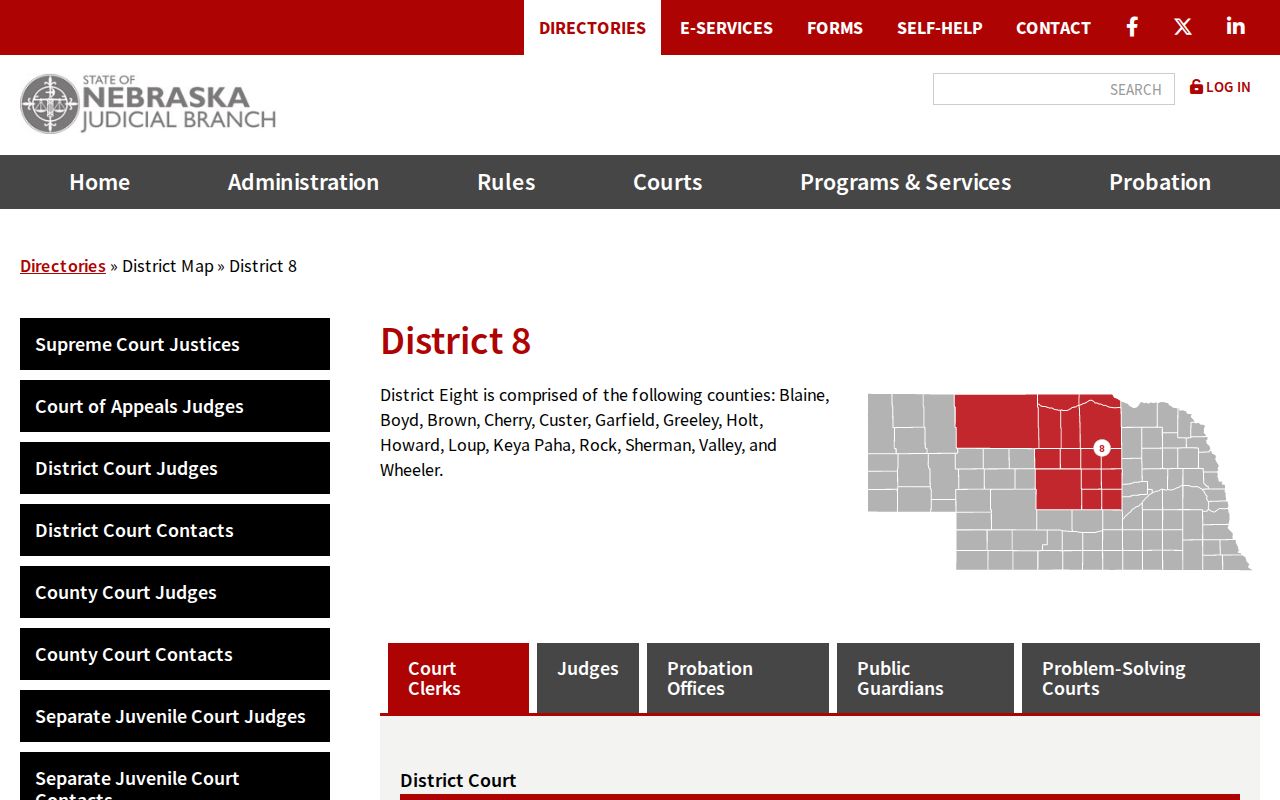
The map gives you the court structure. The Garfield County case number and its later entries remain the sure way to follow one case through the courts.
Access Rules for Criminal Dockets
Nebraska opens its criminal court records in several ways. JUSTICE, authorized remote access, and clerk public terminals all carry public case information under Nebraska Supreme Court Rule Chapter 1, Article 8. Rule §2-215 goes further. Filings are public under that rule unless a law, rule, or court order says otherwise. Free JUSTICE access is available at authorized courthouse and law-library kiosks. The local kiosk location is not published, so ask the clerk.
An empty online result proves little. A Garfield County case can be delayed, paper-only, sealed, confidential, or beyond current retention and digitization. Juvenile matters run through County Court here. A sealed juvenile record stays closed to public inquiry. For a restricted or older file, ask the clerk about the lawful route in.
Public-access limits: Neb. Rev. Stat. §43-2,108.05 limits public inquiry after a juvenile record is sealed. Nebraska Public Records Act §84-712.05 preserves protected and exempt information. Neither route overrides a sealed or confidential court file.
The Article 8 public-access rule spells out the state system's public information, images, calendars, and restrictions.
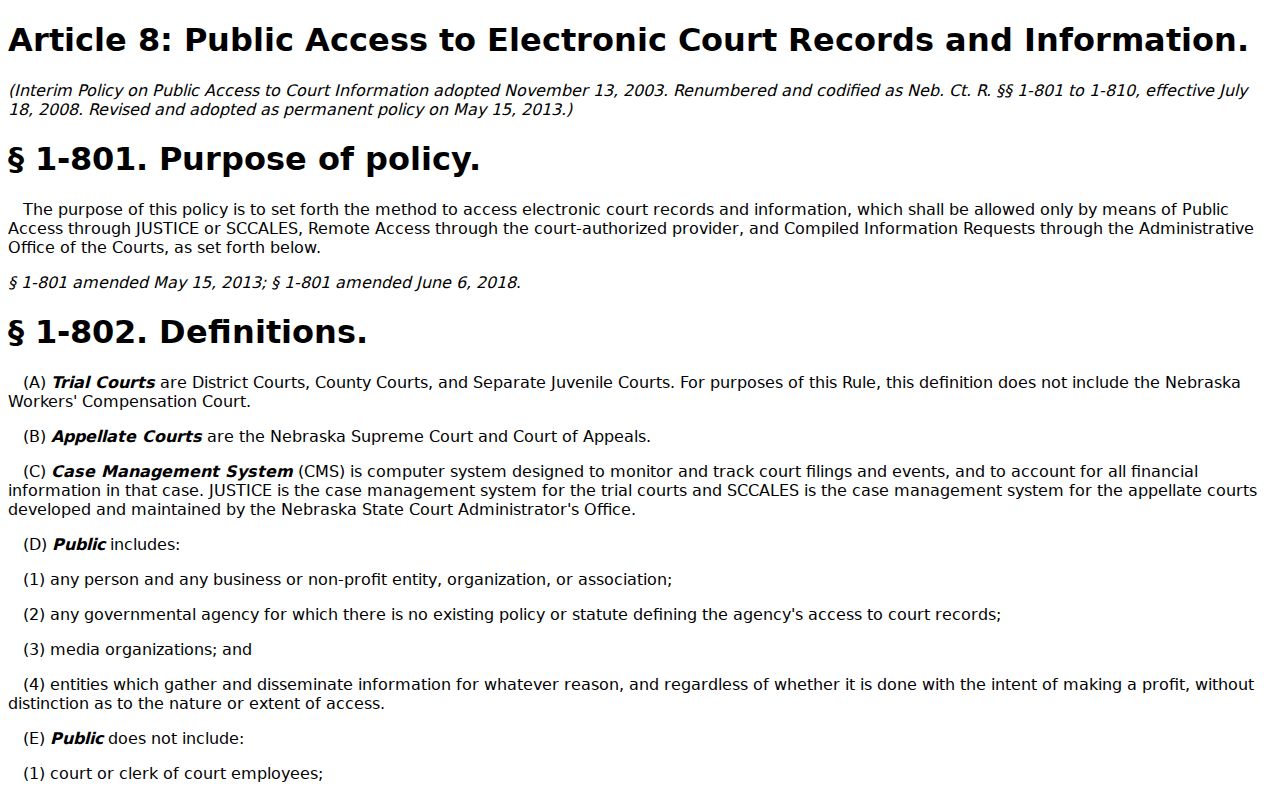
The rule explains a common puzzle. A register entry can be visible in a Garfield County criminal record while the document behind it stays unavailable.
Garfield County Criminal Copy Routes
Sometimes the online image is missing. Sometimes you need a certified record. Either way, start with the state copy-request instructions and form CC 3:29. File it with the clerk who holds the case. The form asks for the court, county, case number, case name, the document you want, and your delivery choice. Prepayment is required. Ask before you mail. Call the County Court or the District Clerk to confirm payment and delivery details first.
Fees depend on format. An emailed non-certified copy carries no charge on CC 3:29. A mailed plain copy runs $0.25 per page. An electronic certified copy is $1 per request. A mailed certified copy costs $1 per seal plus $0.25 per page. One caution from the Garfield County FAQ applies. Police reports or evidence tied to a pending charge may need a court order. The copy route never overrides case-specific access rules for that material.
The District Clerk lists PO Box 218, fax 308-346-4651, and clerk@garfieldcountyne.gov. The state County Court directory lists PO Box 431 and fax 308-346-4069. Use the copy form for any defined request. Then call to confirm the accepted delivery method, payment, and any restriction on the specific Garfield County criminal document. Identify the court, the case number, the document, and the copy type. The clerk can then tell you whether the item is available at all.